Ontario Police Now Scan Licence Plates Automatically: How ALPR Helps Catch Uninsured Drivers
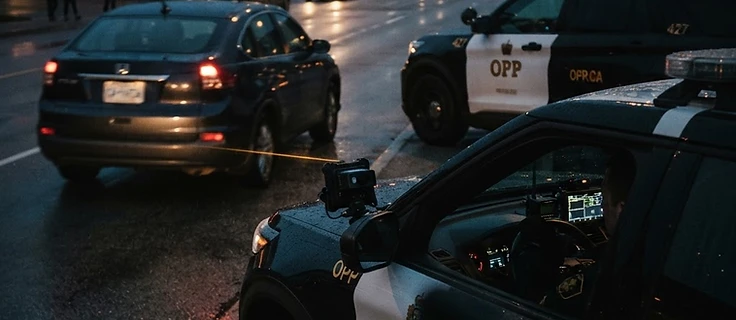
Ontario police cruisers now scan thousands of licence plates an hour with Automated Licence Plate Recognition and flag vehicles in poor standing, including drivers whose insurance an MTO check shows as unconfirmed. Here is how the technology works, what it actually checks, the penalties for driving without insurance, and what every Ontario driver should do before the next cruiser passes.
Ontario police can now scan your licence plate automatically as their cruiser passes, and the system flags plates in poor standing, including drivers whose insurance an Ontario Ministry of Transportation check shows as unconfirmed. The technology is called Automated Licence Plate Recognition, or ALPR, and it has moved from a niche tool into the mainstream of Ontario policing. Peel Regional Police alone have roughly 415 patrol vehicles equipped, the Waterloo Regional Police Service reports that the majority of its cruisers now carry it, and the Ontario Provincial Police, Toronto Police Service, Hamilton Police, Windsor Police, and services across the province deploy it daily. For a driver, that means a plate in poor standing, an expired validation tag, a suspended driver, a stolen vehicle, or a vehicle whose insurance is unconfirmed, can draw a police stop without an officer ever typing the plate in by hand.
This guide lays out, using only verifiable public sources, how Ontario's ALPR system actually works, what it checks and what it does not, how insurance status enters the picture, the penalties for driving without insurance, the privacy rules that govern the scans, and what every Ontario driver should do before the next cruiser passes.
In short
Ontario police use Automated Licence Plate Recognition cameras mounted on cruiser windshields to scan licence plates automatically and continuously, comparing each plate against a "hot list" maintained by the Ontario Provincial Police and the Ministry of Transportation. The hot list flags plates in poor standing, including suspended drivers, stolen vehicles, suspended plates, and expired validation tags, and when a plate hits, the officer stops the vehicle and runs an MTO check that can show the vehicle's insurance as unconfirmed. Ontario police have explicitly described using ALPR to stop uninsured drivers. Drivers must carry proof of insurance, on paper or as an FSRA-approved electronic pink slip, and driving without valid insurance carries a minimum $5,000 fine on a first conviction plus a 25 percent victim fine surcharge.
Shop 17+ insurers in one go.
Get a free quote and a dedicated Ontario broker who explains every option and stays with you to renewal.
Start your quoteWhat Automated Licence Plate Recognition actually is
ALPR is a camera-based system mounted on the windshield of a police cruiser that points forward and reads the licence plates of vehicles in front of it as the officer drives. The Waterloo Regional Police Service describes it plainly: the camera scans cars in the surrounding area of the cruiser, and under optimal conditions the system is capable of scanning thousands of licence plates per hour. Peel Regional Police explains that the equipment uses colour and infrared cameras and software to photograph and identify licence plates, compares the photograph against lists of plates linked to a variety of offences, and alerts officers with a sound and a message if an offence is detected. The system also reads out-of-province plates.
The important distinction is what ALPR does and does not do on its own. The camera reads the plate. The software then compares that plate against a database. It does not, by itself, read a live "insured or not insured" flag from an insurance company in real time. The insurance connection comes through what the database flags and what an officer verifies on a stop, which is the part worth understanding precisely.
How the hot list works
The database at the heart of the system is called a hot list. According to Peel Regional Police, the hot lists are maintained by the Ontario Provincial Police and the Ministry of Transportation, and Peel updates its hot lists every morning. The Waterloo Regional Police Service explains that officers assigned an ALPR-equipped vehicle have access to an Ontario Ministry of Transportation and Canadian Police Information Centre hot list, a database that contains millions of licence plates in poor standing. When the ALPR camera scans a plate registered to the hot list, it produces a hit, alerting the officers on a monitor in the cruiser.
The categories WRPS lists for a plate in poor standing are specific and verifiable:
- Plates that belong to a driver with a suspended licence.
- Plates associated with stolen vehicles, or reported stolen or missing.
- Plates that have been suspended.
- Plates with expired validation tags.
- Plates associated with persons with outstanding Canada-wide warrants or who are reported missing.
A point WRPS makes explicitly: the information stored in the hot list is information already available to officers if they ran your licence plate on the computer in their car themselves, it does not give them access to any new information. What ALPR changes is scale and automation. Thousands of plates an hour are read passively, instead of one at a time by an officer who has already decided to run a plate.
How insurance enters the picture
Here is the part that connects plate scanning to insurance, and it works on two layers.
The first layer is the hot list itself. An Ontario vehicle needs valid insurance to renew its validation, so a plate with an expired validation tag is a plate whose insurance status is, at minimum, stale. That is one of the categories ALPR flags directly, and it is the most common pathway by which a plate scan leads to an insurance question. A driver who let the sticker lapse often let the insurance lapse too, and the expired-tag hit pulls the vehicle into a stop where the officer then verifies the actual insurance status.
The second layer is the MTO check an officer runs once the vehicle is stopped. The Ontario Provincial Police has described this directly: an ALPR alert led an officer to a vehicle with an expired registration, and an MTO check showed unconfirmed insurance for the vehicle. The OPP has stated that Ontario police use ALPR cameras to stop uninsured drivers. So the accurate description of how the system works is this: the hot list flags the plate for a standing problem such as an expired validation tag, the officer stops the vehicle, and an MTO check can then show the vehicle's insurance as unconfirmed, which is what lets police act on an uninsured vehicle they would otherwise have no reason to pull over.
What ALPR does not do is read a live, insurance-company-fed "insured or not insured" signal in the instant the camera passes. The hot list is built from Ministry of Transportation and police data, updated on a daily cycle, and it flags standing, not a real-time insurance policy lookup. But because an expired validation tag and an MTO check together can surface an uninsured vehicle, the practical effect for drivers is the same: a plate scan can lead to an insurance stop.
Proof of insurance: the paper pink slip and the digital version
Once a vehicle is stopped, the officer will ask for proof of insurance, and Ontario law requires drivers to carry it at all times. The classic proof is the paper pink card, but Ontario drivers can now also carry an electronic version. The Financial Services Regulatory Authority of Ontario, or FSRA, approved the use of electronic proof of auto insurance effective September 5, 2019, so insurers may provide an electronic insurance card that serves as proof on a mobile device. Consumers can keep the electronic card instead of, or in addition to, the paper version, and the paper pink card is not being eliminated.
Three responsibilities come with the electronic option that are worth knowing:
- A driver must be able to show proof of insurance regardless of device problems such as poor cellular service, a drained battery, or a damaged screen. The paper card is still the reliable backup.
- Insurance providers offering electronic cards must include lock-screen capability, but it remains the driver's responsibility to enable the screen lock and protect personal information.
- It is still the law to have proof of auto insurance in the vehicle at all times, in paper or electronic form, and to show it to a police officer when asked.
The practical point for an ALPR stop is simple. If an MTO check flags unconfirmed insurance, the fastest way to resolve it on the shoulder is current, accessible proof of insurance, whether a paper pink slip or an FSRA-approved digital one on a phone with charge. A driver who cannot produce it turns a flag into a charge.
The penalties for driving without insurance in Ontario
The reason an ALPR insurance stop matters is that driving without valid insurance is one of the most heavily fined offences on Ontario roads. Under Ontario's Compulsory Automobile Insurance Act and the Highway Traffic Act framework, the penalties are set by the courts and are serious:
- A first conviction for driving without insurance carries a fine of $5,000 to $25,000.
- A subsequent offence within five years carries a fine of $10,000 to $50,000.
- A 25 percent victim fine surcharge is added on top of the fine.
- A conviction can also bring a driver's licence suspension and other consequences.
The Ontario Court of Justice publishes these set fines through Schedule 43 of its provincial offences materials, and the structure is consistent across legal sources in the province. A first offence is often cited at roughly $6,255 once the $5,000 minimum fine, the 25 percent victim surcharge, and court costs are combined. These figures are the floor, not the ceiling, and a repeat offence within five years multiplies the exposure. For a driver caught through an ALPR stop, the cost of being uninsured is measured in thousands of dollars and a possible suspension, not a ticket that can be paid and forgotten.
How privacy rules govern the scans
ALPR reads every plate it passes, which is why Ontario's privacy framework around it matters. The Information and Privacy Commissioner of Ontario has published guidance on the use of ALPR systems by police services, and the technology is operated under the Municipal Freedom of Information and Protection of Privacy Act, or MFIPPA, for municipal services. Two retention rules from Peel Regional Police show how non-hits are handled:
- If there is a match, the scan is stored for 30 days.
- If there is no match, the scan is kept for 24 hours and then deleted.
WRPS makes the same point: if your licence plate is a non-hit, the officer is not even notified that your plate was scanned, and all information related to a non-hit is deleted. The system is designed to flag plates in poor standing, not to build a movement record of every compliant driver. For a driver with valid insurance, current validation, and a clean driving record, a plate scan is a non-event the system is built to forget.
Who is deployed and how widely
ALPR is no longer a pilot. Across Ontario the deployment is broad and growing:
- Peel Regional Police have approximately 415 patrol vehicles equipped, with provincial funding.
- The Waterloo Regional Police Service reports the majority of its cruisers are now equipped.
- The Ontario Provincial Police use ALPR province-wide, and were the first in Ontario to target suspended drivers through an enhanced program that gave OPP ALPR vehicles access to an MTO database.
- Toronto Police Service, Hamilton Police, Windsor Police, Guelph Police, and Saugeen Shores Police all publish ALPR programs.
For a driver anywhere in Ontario, the working assumption is that a passing police cruiser is reading plates, and that a plate in poor standing will be flagged.
What every Ontario driver should do
A short list closes most of the exposure before the next cruiser passes:
- Keep valid insurance in force at all times. Ontario law requires it, and a lapse is what an MTO check surfaces after an ALPR stop. If your premium is hard to carry, a broker can shop Ontario auto insurance quotes across 17+ insurers before you let a policy lapse.
- Renew your validation on time. An expired validation tag is the most common ALPR hit that leads to an insurance check, and it is fully in your control.
- Carry proof of insurance you can actually show. A paper pink slip, or an FSRA-approved electronic card on a charged phone with the screen lock enabled. Keep both if you can.
- Resolve a suspension before you drive. A suspended-driver hit is one of the standing flags ALPR raises, and driving while suspended is a separate, serious offence. See our Ontario high-risk driver insurance guide if a suspension or cancellation has pushed you out of the standard market.
- Keep your plate clean and readable. An obscured, damaged, or altered plate can itself be an offence and can defeat the purpose of the system, so keep the plate visible and unobstructed.
- Re-shop your auto insurance at every renewal. The cheapest way to stay insured is to never let a premium you cannot afford push you off coverage. A broker who re-shops every renewal keeps the rate honest, and it is how drivers stay covered without overpaying. See our guide to cheap car insurance in Ontario for the full playbook.
The bottom line
Ontario police can now scan your licence plate automatically, and a plate in poor standing, an expired validation tag, a suspended driver, a stolen vehicle, or a vehicle whose insurance an MTO check shows as unconfirmed, can draw a stop without an officer typing a thing. The system does not read a live insurance signal from an insurer in the instant the camera passes, but the hot list it builds, combined with the MTO check an officer runs on a stop, is a real pathway to catching uninsured drivers, and Ontario police have said so directly. The defence is straightforward: keep valid insurance in force, renew your validation on time, carry proof you can show, and let a broker re-shop your rate every renewal so the premium never pushes you off coverage. If you want to compare auto insurance in Ontario across the whole market, start a quote with Truly Insurance and a named Ontario broker will run 17+ insurers the same day. If you are local to us, ask for car insurance quotes in Kitchener and we will run the full comparison for your file.
Where Truly Insurance insures across Ontario
Truly Insurance is an Ontario insurance brokerage, and our team of licensed insurance brokers is authorized to arrange coverage anywhere in the province. Our home office is in Kitchener, at 22 Water St S Ste 100, and our brokers work with clients across the Waterloo Region cities of Waterloo, Cambridge, and Guelph, the Southwestern Ontario corridor including London, Brantford, and Stratford, the entire Greater Toronto Area from Toronto and Mississauga to Brampton and Markham, Eastern Ontario including Ottawa and Kingston, and Northern Ontario including Greater Sudbury and Thunder Bay.
You do not have to live near our Kitchener office to work with us. Every Ontario policy is arranged by a named broker who works with you by phone, email, and video, and our team can quote, bind, and service coverage for any address in the province. Find your city or call (519) 800-4770 and a licensed Ontario broker will reach out the same day.
Frequently asked questions
Can Ontario police scan your licence plate automatically?+
Yes. Ontario police services use Automated Licence Plate Recognition, or ALPR, cameras mounted on cruiser windshields to scan licence plates automatically and continuously. Under optimal conditions the system can scan thousands of plates per hour, and it reads out-of-province plates as well. Peel Regional Police have roughly 415 equipped vehicles and the Waterloo Regional Police Service reports the majority of its cruisers now carry it.
Does the police plate scanner know if my car has insurance?+
Not in real time from an insurer. ALPR compares your plate against a hot list maintained by the Ontario Provincial Police and the Ministry of Transportation that flags plates in poor standing, including suspended drivers, stolen vehicles, suspended plates, and expired validation tags. An Ontario vehicle needs valid insurance to renew its validation, so an expired-tag hit often leads to an insurance check, and once stopped the officer runs an MTO check that can show the vehicle's insurance as unconfirmed. The OPP has stated Ontario police use ALPR to stop uninsured drivers.
What is on the ALPR hot list in Ontario?+
According to the Waterloo Regional Police Service, plates in poor standing include plates belonging to a driver with a suspended licence, plates associated with stolen vehicles or reported stolen or missing, plates that have been suspended, plates with expired validation tags, and plates associated with persons with outstanding Canada-wide warrants or reported missing. Peel Regional Police says the hot lists are maintained by the OPP and the Ministry of Transportation and updated every morning.
Can I show my car insurance on my phone in Ontario?+
Yes. The Financial Services Regulatory Authority of Ontario approved electronic proof of auto insurance effective September 5, 2019, so insurers may provide an electronic insurance card on a mobile device. You can carry it instead of or in addition to the paper pink card, which is not being eliminated. You must still be able to show proof even if your device has no signal, a dead battery, or a damaged screen, and you must enable the lock screen to protect your information.
What is the fine for driving without insurance in Ontario?+
A first conviction carries a fine of $5,000 to $25,000, with a 25 percent victim fine surcharge added on top, and a subsequent offence within five years carries $10,000 to $50,000. A conviction can also bring a driver's licence suspension. Once court costs and the surcharge are combined, a first offence is often cited at roughly $6,255, and the figures are published by the Ontario Court of Justice through its set-fines schedules.
How long do police keep my licence plate scan if I am not a hit?+
Peel Regional Police retains a scan for 30 days if there is a match, and for 24 hours if there is no match, after which it is deleted. The Waterloo Regional Police Service notes that if your plate is a non-hit the officer is not even notified your plate was scanned, and all non-hit information is deleted. The technology is operated under the Municipal Freedom of Information and Protection of Privacy Act and guidance from the Information and Privacy Commissioner of Ontario.
What should I do before an ALPR-equipped cruiser passes my car?+
Keep valid auto insurance in force at all times, renew your validation tag on time so it is not an expired-tag hit, carry proof of insurance you can show, paper or FSRA-approved electronic, resolve any licence suspension before you drive, and keep your plate clean and readable. A broker who re-shops your auto insurance every renewal keeps the premium affordable so you never let coverage lapse.
Disclaimer: This article is for general information only and is not financial or insurance advice. Rates, coverage, and eligibility vary by individual circumstances, insurer, and region. Always contact a licensed insurance broker for guidance specific to your situation.
Keep reading

 Guides
Should You Make a Claim or Pay Out of Pocket? How a Claim Affects Your Premium
Paying for a small loss yourself can cost less than the premium increase a claim triggers, but only when the damage is genuinely small and nobody is hurt. Here is how fault, Ontario's minor at-fault accident rule, accident forgiveness, and home claims actually move your premium.
Read article
 Auto Insurance
Car Insurance for Young Drivers in Ontario: What Actually Sets the Price
A young driver's Ontario premium is built from age, years licensed, driving record, vehicle, address, and coverage, and age is a legal rating factor in this province. Here is what each licence level means for a policy, the discounts worth asking about, and the small disclosure mistakes that cost the most.
Read article
 Auto Insurance
Winter Tire Insurance Discounts in Ontario: What Drivers Need to Know
Every Ontario auto insurer has to offer a winter tire discount, but the percentage, the qualifying window, and the proof are decided company by company. Here is how the discount actually works, which tires count, and what happens if the season does not go to plan.
Read article