When a Student Moves Away for School: How It Changes Auto and Home Insurance in Ontario
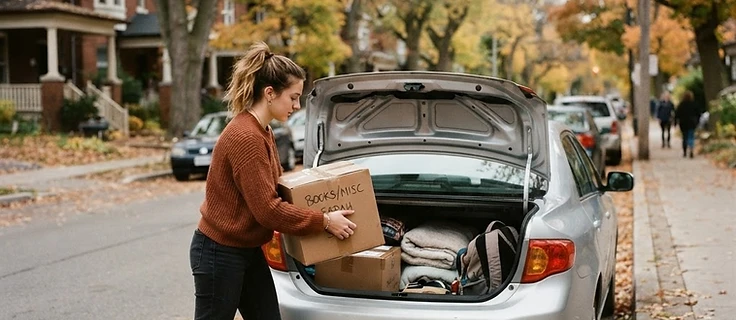
Every September thousands of Ontario students head to university or college, and most families never think to call their insurance broker. Here is how a student moving away for school can change your auto policy, the away-at-school discount that can cut a listed driver's rate, what happens when the car goes to campus, and the home-insurance belongings gap most parents miss.
Every September, thousands of Ontario families pack a teenager or young adult off to university or college, and almost none of them think to call their insurance broker until something goes wrong. A student moving away for school can change your auto insurance in ways that cut the bill, raise it, or quietly void a claim, depending on whether you tell your insurer what changed. The same move can also change what your home insurance covers for that student's belongings, and the gap there catches more families than any other part of the conversation.
This guide lays out what actually changes when a student moves away for school in Ontario, the away-at-school discount that can lower a listed driver's rate, what happens when the car goes to campus instead of staying home, how Ontario's graduated licensing fits into the math, and the home insurance angle most parents overlook.
In short
- Tell your insurer when a student moves away. A material change in who drives the car or where it is kept can change your policy.
- An away-at-school or distant-student discount may apply when a listed driver attends school far from home without the car. Distance and age rules vary by insurer.
- If the car goes to campus, the garaging address may change the rate, and an out-of-province move needs to be addressed with your broker.
- Check the belongings gap. Home contents may extend to a dorm up to a sublimit, but an off-campus student usually needs tenant insurance.
Shop 17+ insurers in one go.
Get a free quote and a dedicated Ontario broker who explains every option and stays with you to renewal.
Start your quoteWhat actually changes when a student moves away for school
Two things move at once. First, a driver who used the family car regularly is now somewhere else, and second, the family car may or may not be going with them. Insurers price a policy on who actually drives the vehicle and where it is kept overnight, and a student leaving home can shift either of those facts.
The single most important rule is also the simplest. You have to tell your insurer about a material change in risk. A student who is no longer driving the car daily, or a vehicle that is now kept in a different city overnight, is exactly the kind of change an insurer wants to know about. Telling your broker early is what unlocks a discount where one applies, and it is what keeps a claim from collapsing on an address or use technicality later.
The away-at-school discount: what it is and who qualifies
The away-at-school discount, sometimes called a distant-student discount, is a rate adjustment some Canadian insurers offer when a listed driver, often a child on a parent's policy, attends school far enough from home that they only drive the insured vehicle occasionally, such as during holidays and summer break. The logic is simple. A driver who is rarely behind the wheel of that specific car represents less exposure than one driving it daily, and insurers price that difference into the premium.
The discount is not automatic. A household normally has to tell its insurer that a listed driver has moved away to school, and the insurer then confirms whether the household meets that program's rules.
Who typically qualifies
Insurers set their own eligibility rules, but a few patterns show up across most Canadian programs.
- A minimum distance from home. Many Canadian insurers set a threshold somewhere in the range of 80 to 150 kilometres between the family home and the school. Below that distance, a student is still assumed to have regular access to the car.
- The student is under a set age. Distant-student programs usually apply to a listed driver under 25, the bracket where young-driver rates are highest and a discount matters most.
- No regular use of the vehicle at school. The core condition is that the student is not driving that specific car day to day while away, even if they use it occasionally when home for breaks.
- Proof of enrolment. Insurers commonly ask for confirmation the student is attending a recognized post-secondary institution, such as an acceptance letter or a class schedule.
Because the exact distance, age cap, documentation, and size of the reduction vary by insurer, the details of your own policy are best confirmed with a broker rather than assumed from a general description.
How much the discount is worth
The honest answer is that it varies. The reduction applies to the portion of the premium tied to that listed driver, not the whole policy, and what that is worth depends on how the student is rated, the vehicle, and the insurer. Some drivers describe meaningful cuts on forums, but the only reliable way to know is to have your broker rate it against your actual policy and a handful of insurers at once. The worse mistake is to assume you are already getting it, because most households are not until they ask.
If the student takes the car to school
The away-at-school discount generally assumes the student is not the one regularly using the insured vehicle in the city where they study. That assumption breaks the moment a family sends a car with the student, and it is one of the more common ways this topic comes up with a broker.
If a student is taking a vehicle to school for most of the year, most insurers expect the household to disclose that as a change in how the car is used and where it is kept overnight. Two things can happen.
First, the garaging address can change the rate. Ontario auto premiums are partly territory-rated, meaning the postal code where the car is kept overnight is a real rating factor. A car moved from a Kitchener or Mississauga postal code to a London, Ottawa, or Toronto student address can land higher or lower depending on the claims experience of each area, and the only way to know is to re-rate it.
Second, if the school is out of province, the question gets more complicated. Auto insurance in Canada is regulated provincially, and a policy written in Ontario is built around Ontario's requirements. A vehicle based for months at a time in another province may need to be addressed with the insurer, whether through an update to the existing policy or a separate policy in the new province. Guessing here is exactly the kind of mistake that surfaces at claim time, so confirm with a broker before the move.
Staying on the parents' policy or setting up a new one
For students who leave the car at home and rely on transit, walking, or occasional access to a parent's vehicle, staying listed on the family policy as an occasional driver is the common approach, and it is what the away-at-school discount is designed for. It is usually cheaper than a standalone policy, and it keeps the student's continuous insurance history intact, which insurers look at when they rate a policy later.
For students bringing their own car, or a family car that stays with them for most of the school year, some households look at whether a separate policy in the student's name makes more sense. The trade-offs include how often the car comes home, whether the student has an independent driving history worth building, and whether household bundling still saves money with the car physically located elsewhere. A broker can walk those variables for a specific family rather than applying a generic rule.
The one mistake to avoid on both paths is a gap in coverage. Even while a student is not actively driving, a lapse in continuous insurance history can affect how they are rated the day they buy their own policy. Staying listed, even at a reduced occasional-driver rate, is one of the cheapest ways to protect a young driver's future insurability.
Ontario's graduated licensing and how it fits
Most students leaving for post-secondary school are somewhere inside Ontario's graduated licensing system, and where they sit in it changes the math.
- A G1 learner cannot drive alone and is not rated the same way, because they must always drive with a fully licensed accompanying driver.
- A G2 driver can drive unsupervised but still carries restrictions, and insurers rate a G2 young driver meaningfully, especially without a completed driver-training course on file.
- A full G licence removes the graduated restrictions and generally improves the rating picture as driving experience builds.
If a student completes an approved driver training course before or during school, that completion can support a discount that lasts years, and it is one of the highest-value moves a young driver can make on the rating side. If a student is away at school without the car, confirm with your broker that their licence level and away status are both rated correctly, because a stale file is a quiet overpay.
The household-listed-driver rule
Insurers generally want every licensed driver in the household who might drive the car to be disclosed, usually as an occasional driver. A student who lives at home during the summer and away at school during the year is still part of that household picture, and how they are rated should reflect where they actually are.
The risk on the other side is the unlisted regular driver. If a student is regularly driving a car at school and was never disclosed to the insurer, a claim can be denied or paid at a reduced amount on the basis that the driver was not properly rated. Disclosing the arrangement honestly, whether occasional use from home or regular use at school, is what keeps a covered claim standing.
The home insurance angle most parents miss
Auto is where most of the conversation lives, but the move can also change what a parent's home insurance covers for that student's belongings, and this is the part families usually get wrong.
A standard Ontario home insurance policy covers personal property at the insured residence, but it can extend to a dependant temporarily living away at school, usually up to a sublimit, often around 10 percent of the contents limit or a capped dollar amount, for property at a temporary residence such as a dormitory. That extension is reassuring, but it has limits and conditions worth checking, and it generally does not replace what tenant insurance is built to do.
For a student in a leased apartment or off-campus house, the better answer is usually a tenant insurance policy in the student's name. It covers the student's laptop, bicycle, and belongings at the school address, carries liability if a guest is injured or the student accidentally damages the rental, and stays with the student through moves. The cost is modest, and several insurers bundle a tenant policy with the family auto and home for a multi-line discount that can offset much of the premium.
Students heading to the Kitchener-Waterloo and Guelph corridor
If your student is staying inside Ontario's most concentrated student corridor, the same rules apply, but the local context matters. The University of Waterloo, Wilfrid Laurier University, and Conestoga College anchor the Kitchener, Waterloo, and Cambridge market, and the University of Guelph sits minutes down the road, all of it inside a short drive of our Kitchener office. A student moving from a family home in Toronto, Mississauga, or Brampton to a Waterloo or Guelph address is changing the garaging postal code, and territory rerating can land differently in each. A student who already lives in Kitchener or Cambridge and commutes to one of these campuses carries a different use profile than one who has moved away. Either way, tell your broker the actual address and how the car is used, so the policy rates the right territory and the right driver.
Guidelines before the semester starts
A short list closes most of the exposure before the car is packed.
- Tell your broker the student is leaving for school before the move. Saying it early is what unlocks any away-at-school discount and keeps the file accurate.
- Ask for the distant-student discount by name if your student is far enough away and not taking the car, and confirm the distance and age rules with your insurer.
- Disclose whether the car is going. If the vehicle goes to campus, update the garaging address and re-rate the territory. If it stays, confirm the student is rated as an occasional driver with away status.
- Handle out-of-province moves with your broker. A car based in another province may need a policy update or a new policy, and guessing is not a strategy.
- Check the student's licence level. Confirm G1, G2, or full G is rated correctly, and make sure any driver-training completion is on file for the discount it deserves.
- Verify the belongings picture. Check whether your home contents extend to a dormitory sublimit, and buy tenant insurance for a leased apartment or off-campus house.
- Avoid a coverage gap. Keep the student listed as an occasional driver if that preserves continuous insurance history, even when they are not driving.
- Re-shop at renewal. Distance, licence level, and use all change as a student progresses, and a broker who re-rates the market every year keeps the cost honest.
The bottom line
A student moving away for school can quietly lower or raise what you pay, and the difference is almost always whether your insurer knows what changed. Tell your broker before the move, ask for the away-at-school discount where it applies, disclose whether the car is going and where it is garaged, and check the belongings gap before the laptop leaves the house. Start a quote with Truly Insurance and a named Ontario broker will rate your student file against 17-plus insurers, set the listed-driver and address details correctly, and tell you exactly where any discount lands.
Where Truly Insurance insures across Ontario
Truly Insurance is an Ontario insurance brokerage, and our team of licensed insurance brokers is authorized to arrange coverage anywhere in the province. Our home office is in Kitchener, at 22 Water St S Ste 100, and our brokers work with clients across the Waterloo Region cities of Waterloo, Cambridge, and Guelph, the Southwestern Ontario corridor including London, Brantford, and Stratford, the entire Greater Toronto Area from Toronto and Mississauga to Brampton and Markham, Eastern Ontario including Ottawa and Kingston, and Northern Ontario including Greater Sudbury and Thunder Bay.
You do not have to live near our Kitchener office to work with us. Every Ontario policy is arranged by a named broker who works with you by phone, email, and video, and our team can quote, bind, and service coverage for any address in the province. Find your city or call (519) 800-4770 and a licensed Ontario broker will reach out the same day.
Frequently asked questions
Does my Ontario auto insurance go down when my child moves away for school?+
It can, through an away-at-school or distant-student discount some insurers offer when a listed driver attends school far enough from home and does not take the car. The discount is not automatic, you have to tell your insurer, and the distance, age, and terms vary by insurer. A broker confirms whether your policy qualifies and rate it accordingly.
How far away does a student have to be for the away-at-school discount in Canada?+
Many Canadian insurers set a threshold somewhere in the range of 80 to 150 kilometres between the family home and the school, though the exact distance varies by insurer. The student also usually has to be under 25 and not have the car at school. Confirm the exact rule for your policy with a broker.
Do I have to tell my insurer if my student takes the car to school?+
Yes. If the vehicle is kept overnight in a different city, that is a change in garaging address and use, and territory rerating can raise or lower the premium. If the school is out of province, the policy may need to be updated or replaced with one in the new province. Failing to disclose a material change can affect a claim.
Can a student stay on their parents' car insurance while away at school?+
Yes, and it is usually the cheaper choice. Staying listed as an occasional driver keeps the student's continuous insurance history intact and often costs less than a standalone policy. The decision depends on whether the student brings a car, how often they drive, and where they live, so a broker can map it for your household.
Does my home insurance cover my student's belongings at school?+
A standard Ontario home policy can extend to a dependant at a temporary residence such as a dormitory, usually up to a sublimit, often around 10 percent of your contents limit, but it has caps and conditions. For a leased apartment or off-campus house, tenant insurance in the student's name is usually the better answer for belongings and liability.
What happens if my student has a gap in car insurance while away?+
Insurers look at continuous insurance history when they rate a policy, so a gap, even while a student is not driving, can affect how they are rated once they buy their own policy. Keeping the student listed as an occasional driver, even at a reduced rate, is one of the cheapest ways to protect a young driver's future insurability.
Disclaimer: This article is for general information only and is not financial or insurance advice. Rates, coverage, and eligibility vary by individual circumstances, insurer, and region. Always contact a licensed insurance broker for guidance specific to your situation.
Keep reading

 Auto Insurance
Ontario's Most Stolen Vehicles: What Owners Need to Know
Auto theft cost Canadians over $1 billion in claims in 2024, and Ontario is ground zero. Here is the latest list of Ontario's most stolen vehicles, how comprehensive coverage and your deductible decide what a theft actually pays, the anti-theft devices that qualify for a discount, and why two identical cars can land at very different premiums.
Read article
 Guides
The TD Broker Scam in Ontario: How False Brokers Trap Drivers, and How to Verify a Real One
A wave of "TD broker" scams is targeting Ontario drivers, newcomers, and small businesses, and most victims only find out at claim time. Here is how false brokers operate, the gap that lets falsified policies sit undetected, broker vs agent, and how to verify a licensed broker in Ontario.
Read article
 Auto Insurance
Ontario High-Risk Driver Insurance: Who Qualifies, What It Costs, and How to Pay
A DUI, a string of tickets, an at-fault accident, or a cancelled policy for non-payment can push any Ontario driver into the high-risk market. Here is who is considered high risk, what it costs, when you may have to pay your premium in full, which insurers write it, and how to climb back to standard rates.
Read article